
Last updated November 2, 2026
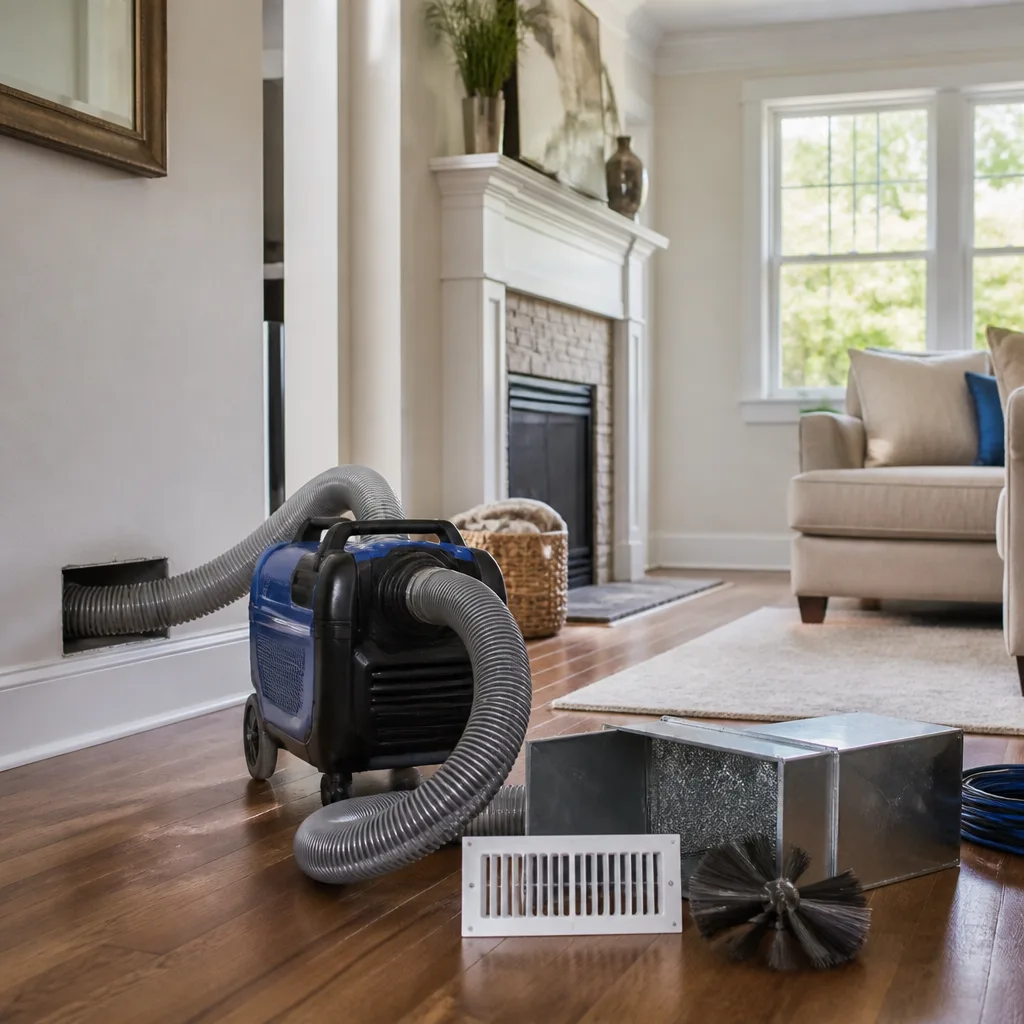 Whole-home duct cleaning
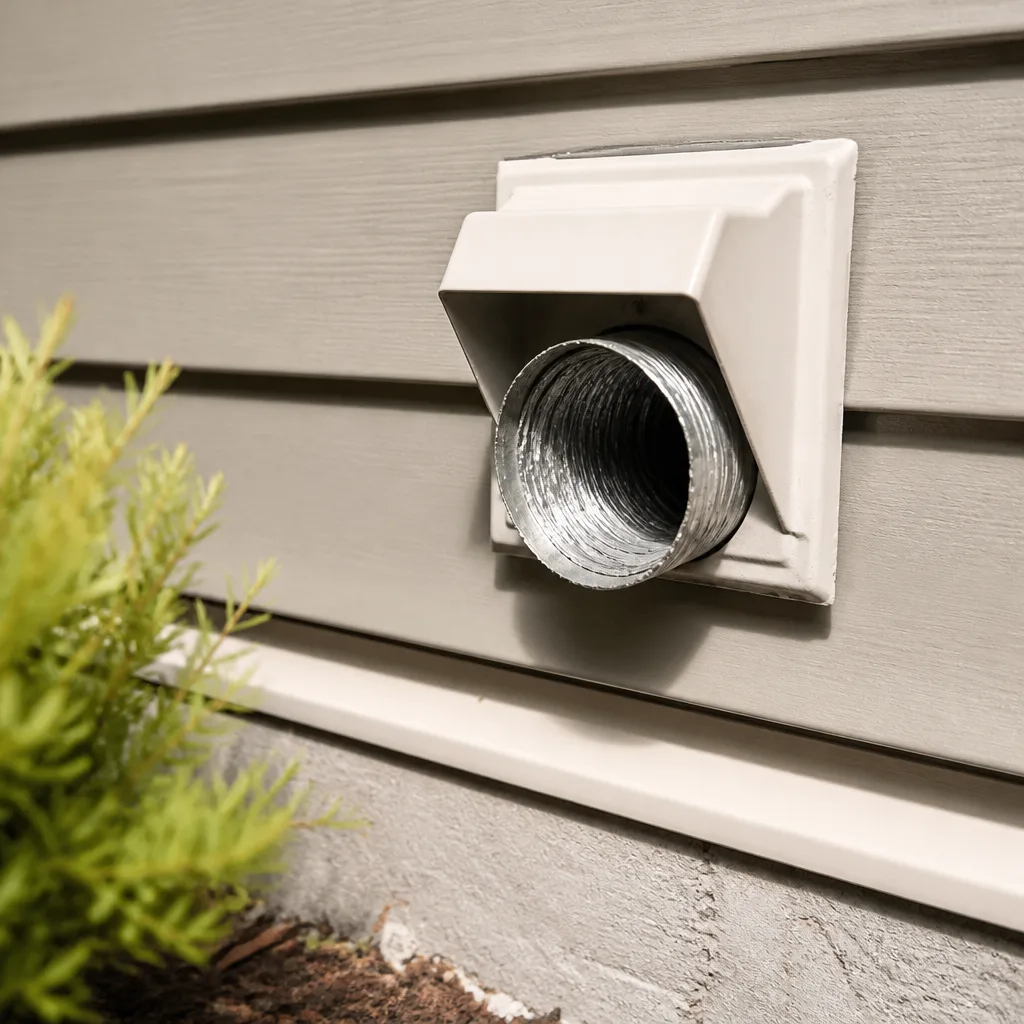 Dryer vent cleaning
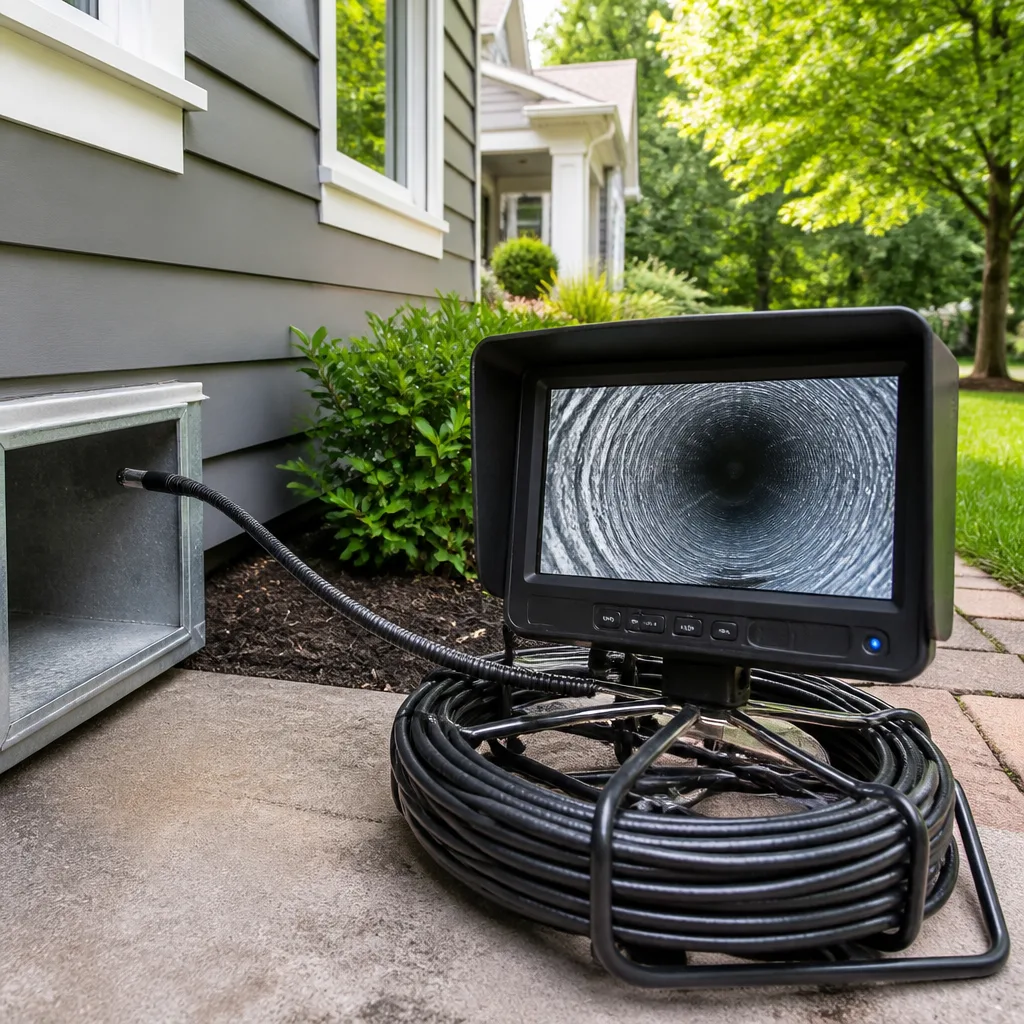 Camera inspection
 Sanitizing & deodorizing
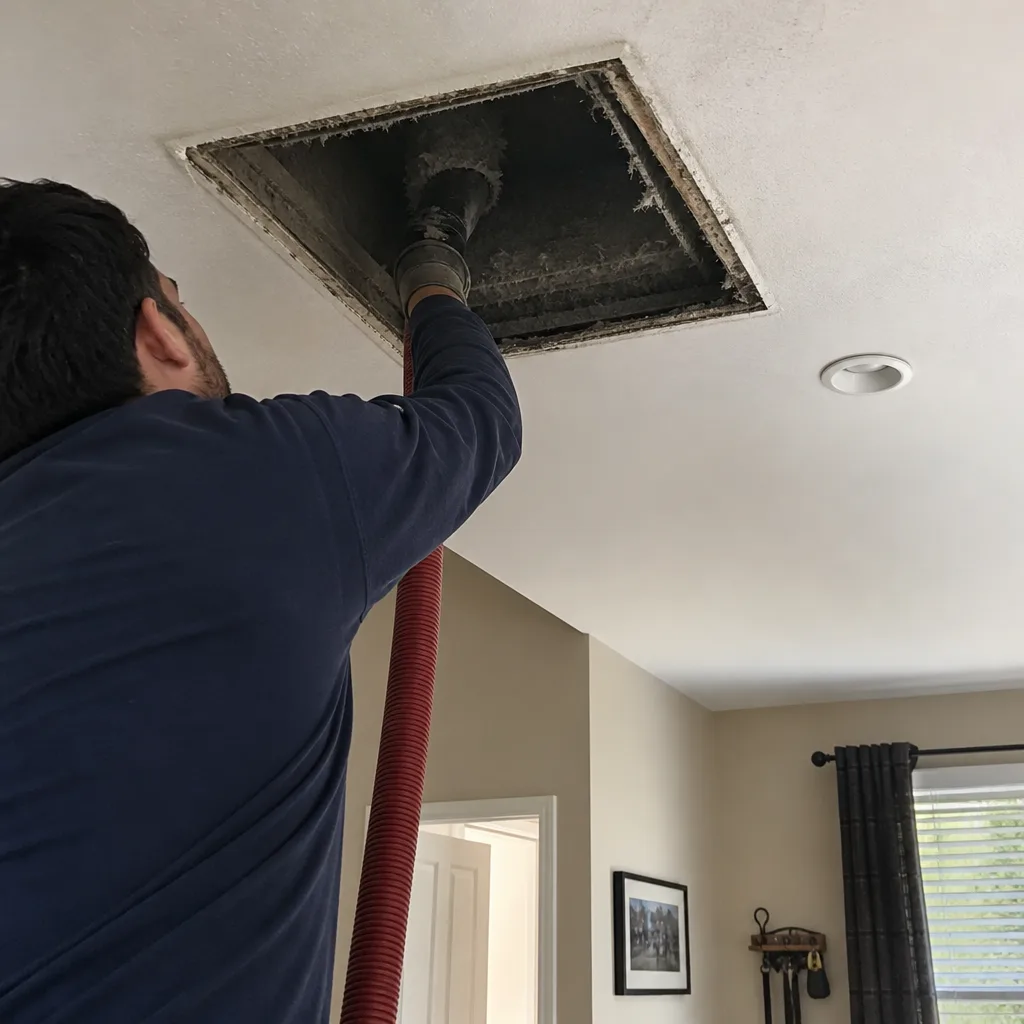
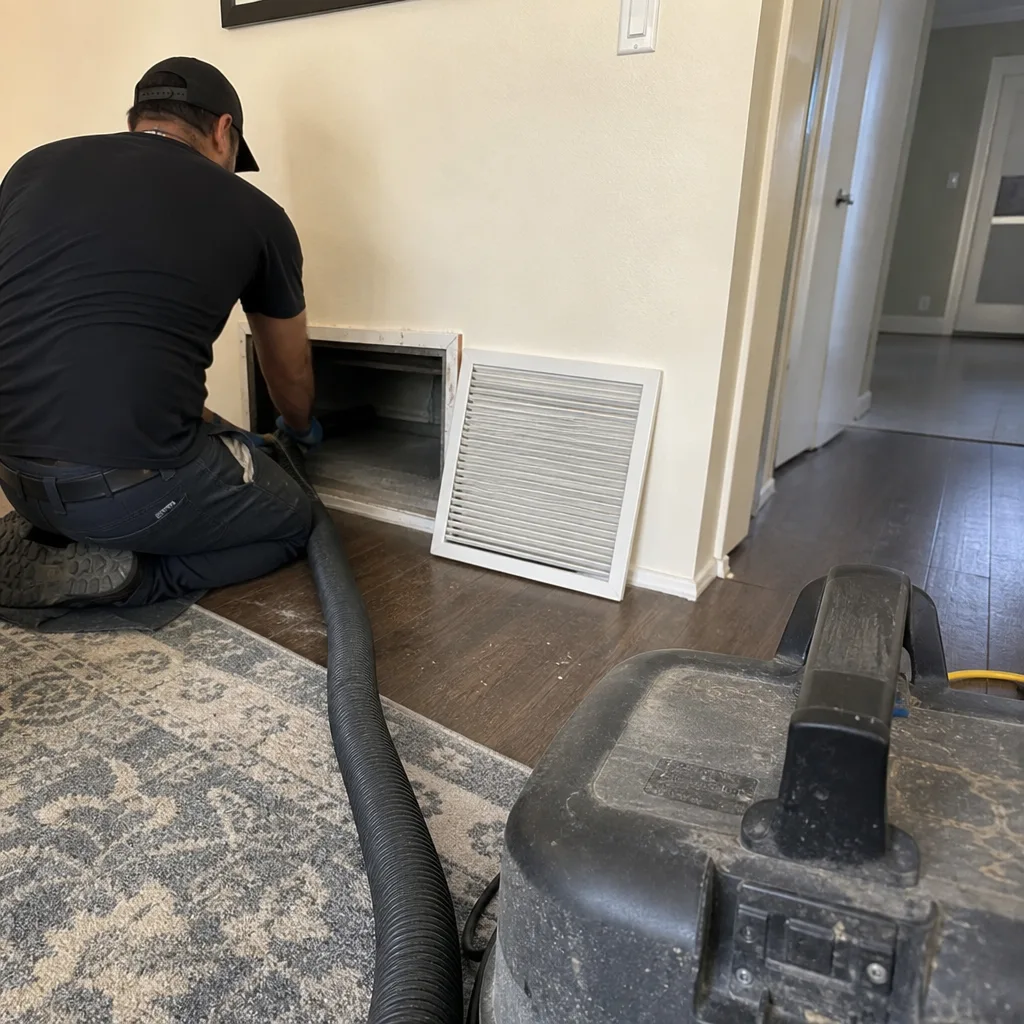
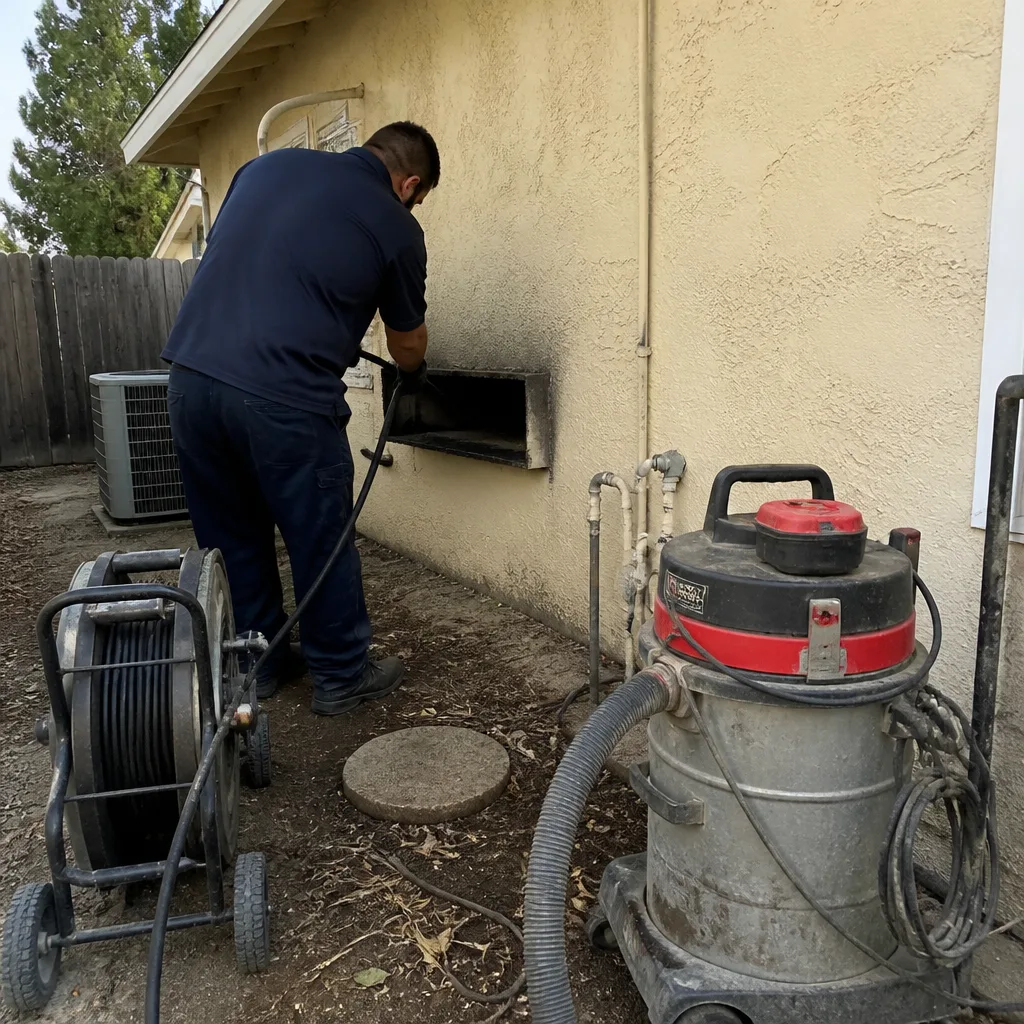
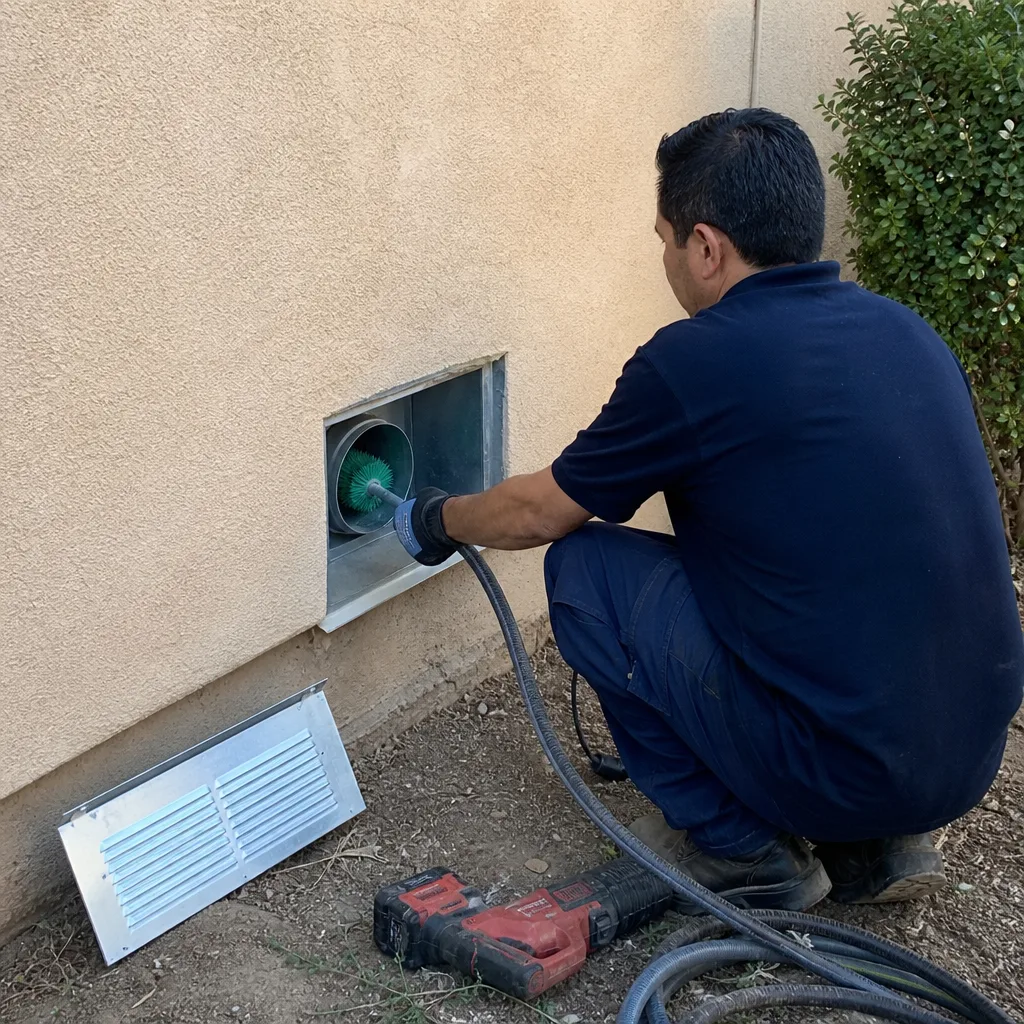
Whole-system duct and dryer vent check with before-and-after photos - you see exactly what came out of your vents
That "$99 whole-house special" is a bait ad - the real number appears once they are in your hallway, or the "clean" is a shop-vac at the register. We photograph the inside of your ducts before and after instead.
DIY vs Professional Air Duct Cleaning: The North Sacramento Homeowner’s Decision Guide
A $200 rotary brush kit from the hardware store will clean roughly the first 18 inches of any duct run. That’s the entire story of DIY duct cleaning, and nobody selling those kits wants to say it plainly. Most of the dust, skin cells, pet dander, and construction debris that recirculates through your North Sacramento home sits four to eight feet beyond the register opening, past the reach of every retail attachment on the shelf. This guide explains exactly what consumer tools do and don’t accomplish, what a homeowner can legitimately handle, and where professional negative-pressure equipment produces outcomes you cannot replicate with a weekend and a shop vacuum.
Styles & brands we work with
- Whole-home duct cleaning
- Dryer vent cleaning
- Camera inspection
- Sanitizing & deodorizing
Quick Answer
For North Sacramento homeowners, DIY air duct cleaning works for register covers, return grilles, and the first visible inches of accessible ductwork, but it cannot reach the deep duct contamination that actually affects air quality. Professional cleaning uses commercial negative-pressure systems like Rotobrush and Nikro equipment that pull from the duct interior while agitating, removing what DIY brushing pushes deeper. The practical answer: do the surface maintenance yourself, schedule professional deep cleaning on an as-needed cycle, and treat the two as complementary, not interchangeable.
Table of Contents
- What a DIY Duct Cleaning Kit Actually Accomplishes
- What Professional Equipment Does That Consumer Tools Cannot
- Six Tasks a North Sacramento Homeowner Can Legitimately Handle
- The Sacramento Attic Reality: Why Summer DIY Duct Work Is Physically Dangerous
- The Hidden Risk of Dislodging Debris Without Extraction
- The Hybrid Approach: Using DIY Work to Extend the Interval Between Professional Cleanings
- Common Mistakes to Avoid
- When to Call a Professional
- Frequently Asked Questions
- The Bottom Line
What a DIY Duct Cleaning Kit Actually Accomplishes
A consumer duct cleaning kit is fundamentally a brush on a stick. Most kits include a flexible rod that extends six to twenty feet, a spinning nylon or wire brush head, and an adapter for a drill or a wet-dry vacuum. And that’s the entire mechanism: spin the brush, knock loose whatever it touches, vacuum what you can reach.
The limitation is geometric, not motivational. A register boot, the metal transition piece behind the wall or floor grille, angles sharply into a horizontal or vertical run. A flexible brush follows that angle for about a foot and a half before friction and rigidity physics stop forward progress. The rotating head loses contact with the duct walls. The result is a clean register opening, a partially cleaned boot, and four to eight feet of duct run that never gets touched.
What a DIY kit can effectively clean:
- Register covers and faceplates (the visible part you see every day)
- The first 12-18 inches of the register boot
- Return grilles and the filter chase
- Visible surface dust on accessible duct interiors within arm’s reach
What it cannot reach or effectively clean:
- The mid-run duct body, where most accumulated dust and pet dander settles
- Flex duct interiors, which resist brush contact beyond the opening
- Main trunk lines above the air handler or along the ceiling of a crawlspace
- Plenum interiors at either end of the air handler
- Debris heavier than light surface dust, including drywall dust from renovations
In North Sacramento homes built before the 1990s, many duct systems are rigid sheet metal, which holds dust differently than the flex duct common in newer construction. Rigid metal ducts accumulate fine particulate along the bottom surface, and a retail brush with a six-inch head skims the top of that layer without extracting it. The dust remains; you’ve just smoothed it over.
What Professional Equipment Does That Consumer Tools Cannot
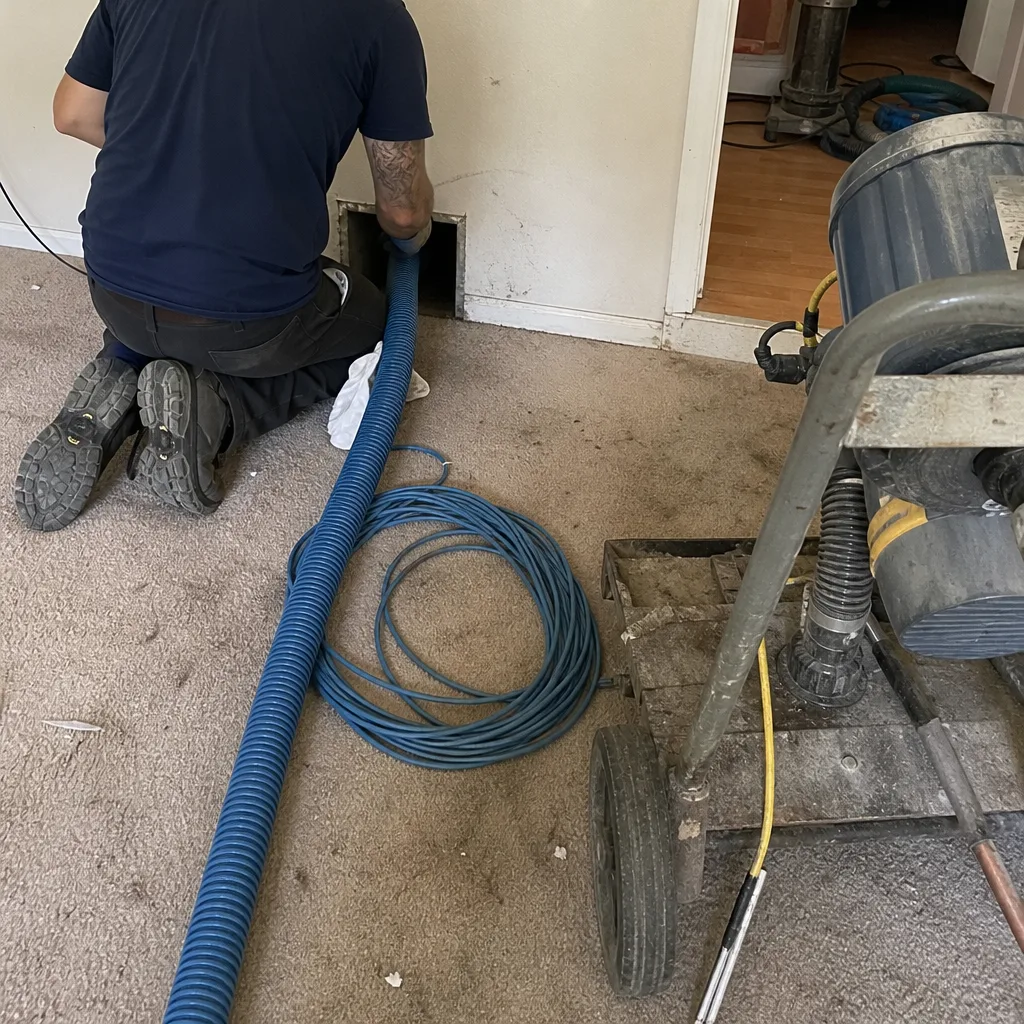
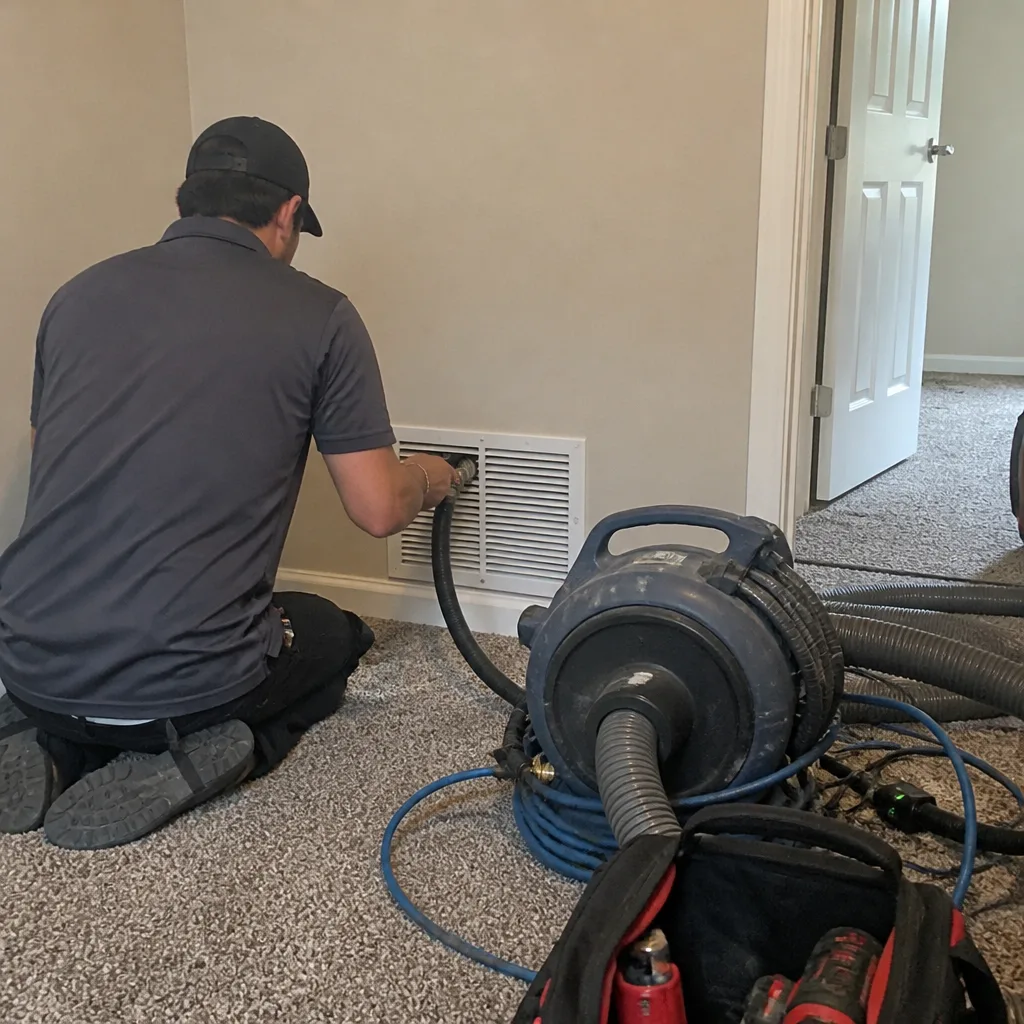
Professional duct cleaning is built around negative pressure extraction. A contractor-grade vacuum unit, like the systems from Rotobrush or Nikro, connects to the duct system and creates continuous suction at the point of agitation. A technician inserts an agitation device, usually an air whip or powered brush on a feed system, and every particle that gets dislodged is pulled simultaneously into the vacuum stream. The debris leaves the system immediately instead of resettling.
That simultaneous agitation and extraction is the technical difference that matters more than any brand name. When we clean ducts, the extraction is active during the entire agitation pass, not applied afterward. That means:
- Dislodged material leaves the duct rather than migrating deeper
- Fine particulate stays contained, not released into the living space at the register
- Heavier debris is captured, including gypsum dust, insulation particles, and small construction remnants
- The air handler is protected from debris that would otherwise settle on coils and blower fins
Equipment quality shows up in reach and containment. A pro-grade system from Rotobrush or Nikro uses a hose feed that navigates the entire duct length, regardless of angles. The agitation tool reaches the far end of the run, and the vacuum pulls debris back along the same path. That’s not a feature consumer kits can claim; it’s the core mechanical difference.
Containment also matters. We run Abatement Technologies equipment when jobs call for it, which means the duct interior stays under negative pressure relative to the home during cleaning. That pressure differential prevents contaminated air from escaping through open registers into the living space. A DIY setup with a shop vacuum at one end does the opposite: it can push loosened dust out through every downstream register in the house.
Six Tasks a North Sacramento Homeowner Can Legitimately Handle
We don’t tell homeowners to keep their hands off everything. Some maintenance is genuinely within reach and worth doing. The distinction is whether the task addresses surface contamination or deep contamination. Here’s what we recommend to customers who want to participate in their own air quality management.
- Register and grille cleaning. Remove the covers, wash them in warm soapy water, dry them fully, and reinstall. Do this quarterly. Register faces collect household dust and pet hair; cleaning them is cosmetic but useful, and it’s a task no professional equipment improves on in any meaningful way.
- Filter replacement on a real schedule. In Sacramento’s summer, when systems run continuously, a pleated MERV 8 or MERV 11 filter captures more particulate and loads up faster. Replace monthly during July through September, and every 2-3 months the rest of the year. A loaded filter restricts airflow and forces the blower to work harder, which increases duct contamination, not just energy use.
- Accessible dryer vent clearing from the exterior outlet. If the exterior dryer vent hood is reachable without a ladder, you can remove the flapper, vacuum the first several inches of visible vent interior, and clean the lint trap housing. Connect with our Dryer Vent Cleaning in South Natomas service for the full interior run, which lint accumulation typically blocks beyond the first three or four feet.
- Return plenum inspection. Pull the return grille, remove the filter, and visually inspect what you can see with a flashlight. Look for visible dust accumulation, signs of pest activity, or moisture staining. This is a diagnostic act, not a cleaning act. If you see heavy buildup, call for a professional evaluation.
- Supply register airflow check. Hold a tissue near each supply register while the system runs. A weak flutter compared to other registers in the same home can indicate a disconnected duct, a closed damper, or a restriction. That’s not something DIY can fix, but identifying the imbalance helps a professional prioritize.
- Visible dust source control. Vacuum carpets with a HEPA-filter vacuum, dust surfaces with a damp cloth, and groom pets regularly. Reducing what enters the living space is as important as removing what’s already in the ducts. The less particulate generated, the slower ducts re-contaminate after a professional cleaning.
None of these tasks replaces professional cleaning. They maintain surface cleanliness and help you spot problems between professional visits. The distinction is clear: surface maintenance is homeowner territory; mid-run and trunk-line cleaning is professional territory.
The Sacramento Attic Reality: Why Summer DIY Duct Work Is Physically Dangerous
North Sacramento attics are not the manageable storage spaces seen in housing magazines. In July and August, roof void temperatures routinely run 140°F or higher, sustained for hours. Radiant heat from the roof deck transfers directly to the air and any surface it touches. Sweating stops. Heart rate climbs. Judgment erodes, which is exactly when a homeowner decides to push through “just a few more minutes” of working over an open duct seam.
A DIY attic duct inspection in summer heat combines multiple hazards that compound each other:
- Heat stress, which progresses from disorientation to heat exhaustion faster than most people expect
- Fall risk from walking narrow ceiling joists while distracted by heat and discomfort
- Insulation contact that can irritate skin, lungs, and eyes in fiberglass or cellulose-filled attics
- Tooling risk from handling metal duct, sheet metal screws, or sharp strap edges in a space with poor leverage and light
- Delayed consequences; a homeowner might finish the job, descend the ladder, and only then experience dizziness, nausea, or cramping
Our technicians work in Sacramento attics year-round, and we plan summer attic work around early-morning slots, hydration, ventilation, and time limits. The difference is experience with heat stress recognition and the ability to stop a job safely before conditions become dangerous. That knowledge comes from repetition, not reading about it, and an injury in an attic is uniquely dangerous because getting a disoriented person down a ladder is itself a two-person task.
For homeowners, the honest guidance is: don’t do duct work in a hot attic. If the attic is where the concern lies, that’s a professional call. If you must inspect visually, do it in early morning, have a second person nearby, set a twenty-minute limit, and descend the moment you feel lightheaded or nauseous. Heat injuries don’t announce themselves with a clear warning; they arrive as a sudden wave of confusion.
The Hidden Risk of Dislodging Debris Without Extraction
The most overlooked problem with DIY duct cleaning isn’t reach; it’s what happens after contact. A brush spinning inside a duct dislodges material from the walls. Some of it gets pulled back by a shop vacuum. The rest behaves like dust shaken out of a rug: much of it stays airborne inside the duct, then resettles further along the run as airflow diminishes. Or it blows directly into the living space through downstream registers the first time the system starts.
We see this pattern in North Sacramento homes, especially after renovation projects. Drywall dust is dense, fine, and surprisingly forward. A homeowner cleans a few registers, thinks the job went well, and then runs the system. The first cycle pushes the dislodged but unextracted dust toward the supply registers in every room. The homeowner now has a dust problem throughout the house that didn’t exist before.
The mechanical issue is pressure differential. Professional cleaning maintains negative pressure inside the duct, so dislodged material travels toward the vacuum, not toward living spaces. A shop vacuum or brush without continuous extraction creates positive or neutral pressure zones, and the material follows airflow, which sends it toward register openings.
If a homeowner insists on brushing accessible duct interiors, two cautions apply:
- Run the fan, not the vacuum. Continuous airflow helps carry dislodged particles toward the return, where the filter captures them, rather than allowing them to settle inside the duct.
- Seal off other registers. Cover supply registers downstream of the one being worked on so dislodged particles cannot escape into those rooms. This creates a partial vacuum effect and routes the material toward the return.
These mitigations reduce the risk but don’t eliminate it. The only complete solution is simultaneous agitation and extraction, which requires professional equipment that maintains vacuum throughout the cleaning pass.
The Hybrid Approach: Using DIY Work to Extend the Interval Between Professional Cleanings
The rational homeowner strategy isn’t DIY versus professional. It’s DIY between professional cleanings. The question is how to combine them to maximize the value of each professional visit and extend the time before the next one is justified.
A home with clean filters, clean registers, and controlled particulate sources will re-contaminate its ducts much more slowly than one with loaded filters, pet hair accumulated around returns, and renovation dust still settling on every surface. If professional cleaning restores the ducts to a clean baseline, surface maintenance keeps that baseline from degrading quickly. The professional visit’s results persist longer because the system isn’t being fed new debris at the same rate.
Here’s a practical sequence for a North Sacramento homeowner:
- Schedule a professional cleaning to establish the clean baseline. This is the foundational step; everything after it is maintenance.
- Replace the filter immediately after the cleaning, then follow the seasonal replacement schedule described above.
- Clean register covers monthly for the first two months, then quarterly. The register face tells you how fast the system is re-contaminating.
- Vacuum around return grilles weekly. The return is where household air enters the system; keeping that zone clean reduces the particulate load entering the ducts.
- Set a reminder to visually inspect the return plenum at six months. If visible accumulation is back, recontamination is happening faster than surface maintenance can offset, and the professional cycle should tighten.
- Repeat the deep professional cleaning on a cycle based on evidence, not a calendar. Most Sacramento homes need it every 2-4 years, but renovation projects, pets, and allergy-sensitive occupants can justify a shorter interval.
The advantage of this hybrid approach is that you’re not wasting money on premature professional cleanings, and you’re not fooling yourself that a brush kit solved a problem it didn’t. Each action matches the scale of the problem it addresses.
Common Mistakes to Avoid
- Buying a duct cleaning kit expecting professional results. The kit cleans the register boot and the first foot of duct. Mid-run contamination stays untouched, and the homeowner has spent money on a false solution. The kit isn’t useless; it’s limited in a way the packaging never explains.
- Using a leaf blower to blow out ducts from the register side. This sends a plume of dust and insulation fragments through the living space, the rafters, and every downstream register. The force can also disconnect poorly supported duct sections in older Sacramento homes.
- Cleaning flex duct with any kind of rigid brush. Flex duct interior liners tear easily, and a tear creates a leak that pulls attic air, insulation particles, and heat into the system. Flex duct is professional territory, always.
- Ignoring the dryer vent while cleaning the HVAC ducts. Dryer vents are a different system with different contamination, mostly lint layered into a flammable mass. Lint accumulation is a documented fire risk, and a blocked vent is the leading cause of residential dryer fires. Our Dryer Vent Cleaning in South Natomas service handles this as its own discipline, not an add-on.
- Disconnecting duct sections to vacuum them from the inside out. Duct sections in many North Sacramento homes, especially those installed decades ago, are connected with sheet metal screws, tape, and crimped seams. Reconnecting them properly requires the right sealant and the right overlap, or the system leaks conditioned air into the attic and pulls contaminated air in. We handle this through Air Duct Repair as a necessary follow-up to poor DIY reconnection work.
- Conflating “I can see it” with “I can clean it.” A borescope inspection shows you what’s there. It doesn’t give you the tooling to remove it. Seeing contamination makes homeowners want to act immediately, but acting with inadequate tools just redistributes it.
- Doing duct work in Sacramento’s summer attic heat. As covered above, 140°F attic conditions create a realistic heat injury risk, compounded by ladder falls and disorientation. No home improvement task is worth a heat emergency in a confined attic space.
When to Call a Professional
Professional cleaning is warranted when the contamination is beyond surface depth, when the system has specific recent history, or when occupants are sensitive enough that partial results aren’t acceptable. Specific triggers include visible dust discharge from supply registers while the system runs, a musty odor that persists after filter replacement, renovation or drywall work within the past year, unexplained dust accumulation on surfaces despite regular cleaning, or a family member with dust-related allergies or respiratory conditions. If a home has never had its ducts cleaned and the system is older than ten years, a professional inspection is the responsible first step. Stonebridge Air Duct Cleaning offers free estimates in North Sacramento – call (833) 467-4303 to schedule an evaluation. We also recommend reviewing our Air Duct Cleaning in South Natomas guide for a full description of how professional cleaning is done and what to expect.
Frequently Asked Questions
Professional air duct cleaning in North Sacramento typically falls in the $350 to $650 range for a standard single-system home, depending on square footage, number of vents, duct accessibility, and contamination level. Homes with flex duct, cramped attic access, or heavy construction debris run higher; simple ranch layouts with rigid metal duct run lower. Per-vent pricing is not a meaningful comparison metric and often signals a bait-and-switch structure. The right way to compare quotes is on total system price, scope of work, and equipment quality. Call (833) 467-4303 for a free estimate based on your home’s specific layout.
The cheap quotes come from companies using consumer-grade equipment, minimal agitation, and short on-site time. A shop vacuum with a brush attachment cannot reach mid-run contamination, so the company charges less because they’re doing materially less work. Some advertise a low per-vent rate and then add charges for returns, main trunk, and air handler access once on site. Professional cleaning with commercial equipment, containment, and full-run agitation costs more because it accomplishes more. The comparison to make is not price alone, but price relative to what’s actually being cleaned.
Ask for before-and-after photos of the duct interior, not just the exterior vents. A professional service using a borescope or camera can document the duct surfaces before and after cleaning. Asking to see the interior is the single most effective verification step, because it tells you whether the mid-run contamination actually came out rather than whether the register faces look bright. Stonebridge provides before-and-after documentation for every cleaning, since the results are invisible from the outside.
For a typical North Sacramento home without renovation activity or unusual occupant sensitivity, a professional cleaning every 2 to 4 years is the evidence-based cycle. Homes with heavy pet loads, occupants with allergies or asthma, or recent drywall work may justify every 1-2 years. Homes with excellent filtration, low particulate generation, and a recent cleaning may go 5 years or longer. The right interval is determined by visual inspection and occupant response, not by a calendar or a marketing pitch. Our Stonebridge Air Duct Cleaning home page describes the full-service approach we apply to every evaluation.
Duct cleaning can reduce the total particulate load recirculating through a home, which matters for allergy sufferers during Sacramento’s spring and fall pollen seasons. But cleaning is not a substitute for filtration. A professional cleaning combined with a quality pleated filter (MERV 8 to 11), and in some homes a whole-home air cleaner from Honeywell or Aprilaire, addresses both the existing accumulation and the ongoing intake. Cleaning removes what’s already in the ducts; filtration manages what keeps entering. The two work together, and neither fully compensates for the other’s absence.
Yes, in measurable ways. Homes built before the 1990s in North Sacramento tend to use rigid sheet metal ducts, which accumulate fine particulate in a dense bottom layer but are straightforward to clean with professional agitation and extraction. Homes built in the 1990s and later commonly use flex duct, which requires gentler agitation methods and is more vulnerable to damage from aggressive DIY brushing. Many North Sacramento homes also have attic-installed systems, which means summer heat stress on the ducts and increased dust infiltration through even small leaks or gaps. Those factors affect cleaning methodology and repair needs, which is one reason local experience matters. We serve the full North Sacramento area including the Air Duct Repair in South Natomas market for homes where cleaning reveals structural issues.
The Bottom Line
DIY duct cleaning reaches the first foot and a half. It’s useful for what it reaches, but the contamination that affects air quality lives further into the system. Professional equipment creates negative pressure extraction with simultaneous agitation, which removed dust doesn’t resettle, which is different. Homeowners who want to participate in their own air quality can handle registers, filters, and accessible dryer vent outlets, but those tasks extend the time between professional cleanings, not replace them. The hybrid approach delivers the best outcome for the money: maintain the surface yourself, engage professionals for the depth, and treat the two as a single strategy. In North Sacramento, where summer heat makes attic work genuinely hazardous and local construction varies by era, the equipment-serious approach is the practical one. Call (833) 467-4303 for a free estimate and a professional assessment of what your ducts actually need.
Written by the team at Stonebridge Air Duct Cleaning, serving North Sacramento since 2014.
See the difference
 Before
 After
 Before
 After
 Before
 After